
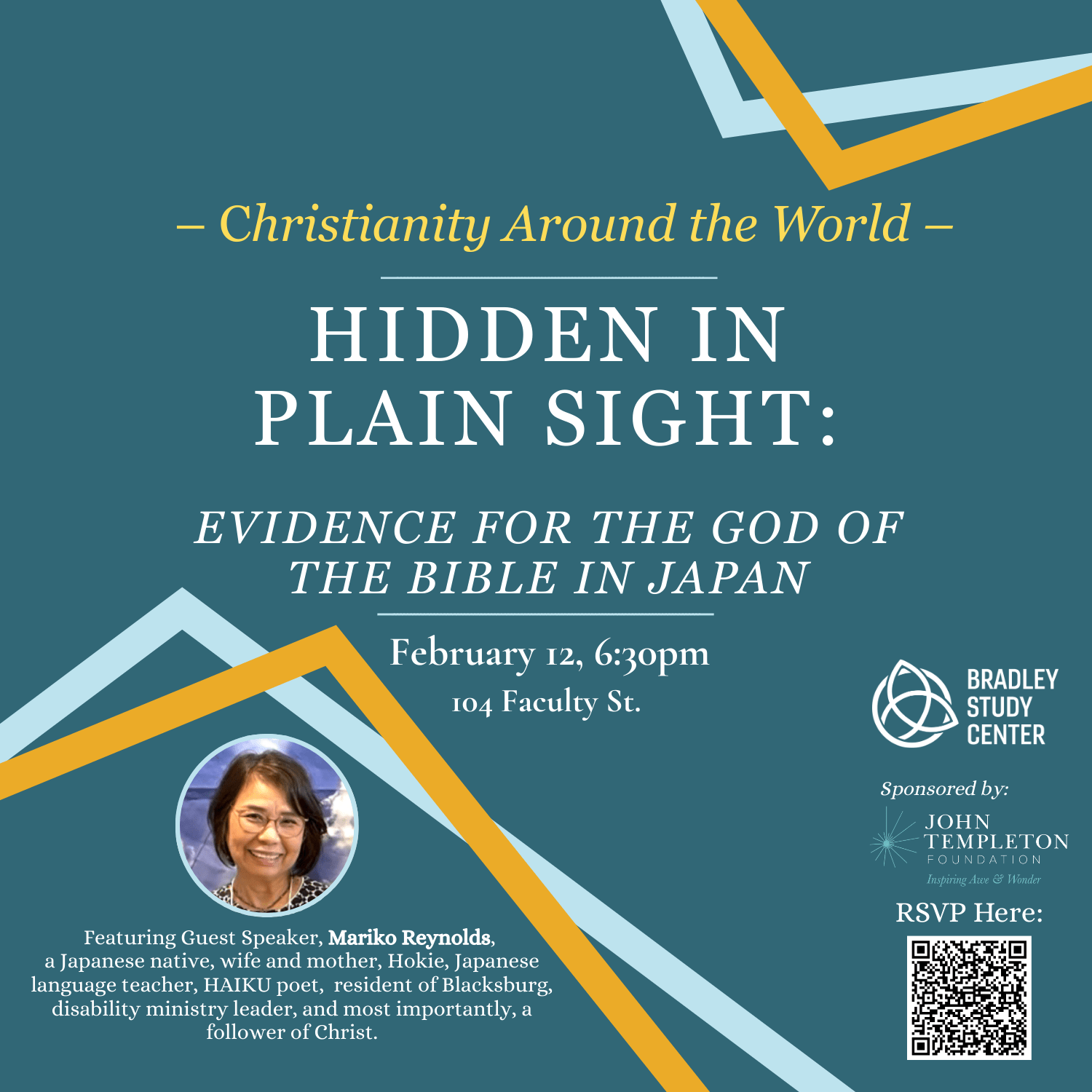
Hidden in Plain Sight: Evidence for the God of the Bible in Japan
While Japan is widely considered one of the most unreached people groups by Christian evangelists, evidence of Christ can be found embedded in Japanese writing systems, its traditions, and its culture. For example, the Japanese alphabet carries a hidden message of the gospel. Numerous characters represent Jesus, his atoning work on the Cross, and how believers should live as a result. Many century-old traditions point to biblical truths of Jesus and His teachings (IKEBANA, SUMO, KIMONO, etc.) Through curious exploration, we can begin to see presence of Christ within Japanese history and be encouraged by God’s movement throughout time and cultures.
We are excited to be kicking off another mini-series this semester, Christianity Around the World! God has been and is at work in many ways across history and cultures, and it is an encouragement and a gift to us to be able to learn more about how he is building his Kingdom outside of our immediate context.
Join us Thursday, February 12 to hear from Guest Speaker, Mariko Reynolds, who will be sharing about the presence and work of Christ in Japan, both across its history as a nation and in our present time.
More about our Guest Speaker:
Mariko Reynolds is a Japanese native, a wife and a mother, a Hokie, a Japanese language teacher, a HAIKU poet, a long time resident of Blacksburg, a disability ministry leader, and most importantly a follower of Christ. Like most Japanese, she grew up in a non-Christian home. She met believers and heard the gospel for the first time in Blacksburg Virginia. Shortly after her baptism, God used her language background to open her eyes to see His unmistakable presence in the Japanese language itself. She finds joy exploring how Christ transforms Japanese people within their cultural context.
This project was made possible through the support of an award from the Stephen & Laurel Brown Foundation, through the support of a grant from the John Templeton Foundation. The opinions expressed in this publication are those of the author(s) and do not necessarily reflect the views of either the Stephen & Laurel Brown Foundation or the John Templeton Foundation.